Controversies make it interesting in biology
George Williams
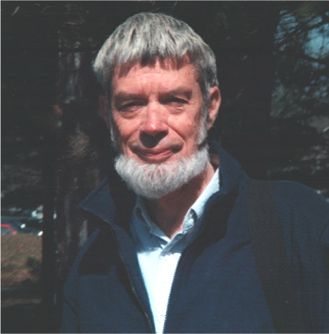
George Williams is a marine biologist and zoologist. He probably was a
'sociobiologist' long before anyone had heard of that term. In Adaptation
and Natural Selection (1966), his famous final line on the theory of
natural selection was: "I am convinced that it is the light and the
way". He is now Professor Emeritus at the State University of New York at
Stony Brook, where the following interview took place on March 21, 1997.
Have you been a biologist all your life?
As a child I was very much interested in different sorts of natural
history and that sort of thing, so I got started in that direction. One of the
things I did in college was take a course in evolution by a really outstanding
evolutionary biologist, named Ledyard Stebbins, a botanist. Even more exiting
than Stebbins himself was the textbook he used, "Genetics and the Origin
of Species" by Dobzhansky. I found that a real revelation. That was the
first time in my career that I got exposed to biological controversies. It was
not just something to learn and to remember, it was something to worry about,
try to figure out.
Come to think of it, there was an earlier influence of that sort. In the
summer of 1947 I spend several weeks with a group from the university of
California digging fossils in the desert. In the evenings we would sit around
the campfire and talk about evolution, and its controversies and problems. Not
as any kind of formal instruction, but just as that sort of thing people were
interested in and that came up for discussion. I think the idea of controversies
is what really makes it interesting in biology.
Thirty years ago you criticized some ideas in biology.
I think that my main criticism was directed at the general assumption
that adaptation characterises populations and species, rather than simply the
members of populations and species. What I did was try to establish the general
rule that natural selection works at the individual level, and adaptations that
are produced are adaptive for those individuals, in competition with other
individuals of the same population, rather than any collective sense for the
population as a whole.
In this perhaps even today the major misunderstanding about evolutionary theory; the idea that something exists because it is good for the species?
Yes, I think that is still a rampant fallacy among those who have not
been brought up in the last few decades in evolutionary biology.
Individual selection would mean that living organisms are not adapted to prevent the extinction of their own species.
That is right. Lets say that there is no very impressive machinery
there that seems to be designed to prevent extinction. Most evolving lineages,
human or otherwise, when threatened with extinction, don't do anything special
to avoid it. I presume that the last pair of passenger-pigeons, which was a
once very abundant bird in North America, now extinct, reproduced the same old
way. Once the species had gotten extremely rare, it did nothing new and did not
take any special measures, the way an individual would if threatened with
death.
On the other hand, we humans in fact have not gone extinct as yet; many
of our relatives have, so I would presume that to some extent the human biology
is biased in favor of attributes that are less likely to extinction. One thing
I think that most people would agree on is that we retain sexual reproduction.
This is a complicated process that is occasionally lost, maybe lost in such a
way that there is no immediate disadvantage.
As a general rule, in plants and in everything else, once you have lost
the sexual process, nothing apparently ever comes from that line of descent.
They don't branch into several new species the way a sexual species might. So apparently
a-sexual reproduction exclusively in any line of descent is a dead end. If
there has ever been a mammal that reproduced a-sexually, it is not around any
more and has no descendants.
If selection works at the individual level, why don't individuals live forever; why do we grow old?
Well, no matter how fit you keep yourself, sooner or later something
will get you by accident: a new epidemic, an attack by terrorists, or an
automobile accident, whatever. Even if you had eternal youth, this would
obviously not assure that you live forever. So the question is, once we attain
our full youthful adulthood, why don't we just stay that way?
Suppose in fact we could do that, lets wave a magic wand, and suddenly
we have eternal youth. In evolution that would not be stable, because eternal
youth does not abolish mortality. If half of us with this eternal youth managed
to live to age one hundred, a quarter to age two-hundred, and one-eight to age
three-hundred, and so on, this would mean that a mutation that would confer
some slight advantage in our twenties and thirties might well be favored, even
if it causes us to drop dead at age three-hundred. Most people are going to
spend time in their twenties and thirties and get the benefits of whatever
that mutation does, but since only one-eight of the population is going to
reach age three-hundred with this eternal youth that I have postulated,
dropping dead then would be worth an advantage earlier in life. So the
evaluation by natural selection of new genetic variability would be biased in
favor of the earlier part of life-histories, and against the later part, until
we had re-evolved to the kind of senescence we have now. Although maybe not as
bad, because in the Stone Age human individuals probably were lucky to reach
maturity.
But I heard that sea-anemones may live forever, how is this possible?
The general rule is that anything that is passed on in reproduction,
does not undergo senescence. So things that can divide in two, and both halves
go on, would ordinarily not have any deterioration with increasing age. You
don't have the kind of trade-off that you have when there is something you can
discard. We can discard our bodies, but our germ-cells are not necessarily
coming to an end. We can pass them on in reproduction to people who in turn
can pass them on in reproduction. So a-sexual reproducing organisms such as
sea-anemones retain eternal youth for the same reason that our germ-cells
retain eternal youth. I think it is the British biologist Tom Kirkwood who
invented the term 'disposable soma'. If you have a disposable soma, that soma
will undergo senescence. I you don't, it won't.
There are all sorts of wonderful adaptations, yet you write that natural selection never designs new machinery. Why did you write this?
Because there is nothing in natural selection that looks ahead and plans
ahead. All it can do is make use of variation that is present. Some things work
better than others, and the ones that work better are the ones that tend to be preserved.
And this is always preserved in relation to immediate circumstances, never
preserved in order to facilitate anything in the future.
You also wrote that every organism shows features that are functionally arbitrary or even maladaptive.
The human body is just full of illustrations of what are really either
arbitrary or in many cases quite unfortunate legacies from prior history. For
instance our respiratory system. Way back half a billion years ago at least,
some early vertebrate didn't have a respiratory system, but it had a digestive
system, that had at the front end a way of taking in water, and running it
through a filter. That machinery turned out to be easily modified to facilitate
respiration, to arrange some special mechanisms for exchanging gasses with the
environment when the organism got big enough that it actually needed that.
Ever since then all descendent vertebrates have had the forward end of the
digestive system and the forward end of the respiratory system very much
involved with each other. This manifests itself in the human body with a
crossing of the two systems in the throat. So there can be, and frequently are,
traffic problems there, the extreme being that you choke to death because you
are trying to eat something. If you could re-design it, you would have completely
separated systems, or they would be connected in a way that doesn't require a
crossing of the two systems.
Another seemingly maladaptive phenomenon: Why would a vital organ like the human male testis be outside the body, where it is quite vulnerable?
For some reason, sperm development has to be at a lower temperature
than that of the rest of the body. This is accomplished by the somewhat
external scrotal structure. This certainly is vulnerable, and I think an
indication of this is that whenever mammals reproduce seasonally, and don't
need to be producing sperm for much of the year, the testicles are retracted
into the body, and only go into the scrotum during the breeding season.
But this sounds like an excuse: We don't know why testicles are outside the body, so it must be temperature.
Oh no, I think it quite obviously is temperature, because any time the
testicular temperature is abnormally elevated, for instance by a high fever,
sterility or defective sperm results.
Still, I think this sounds like making the theory irrefutable.
Well, if you are talking about the general theory, it is not refutable
by any one study. No single observation like this is going to make users of
some major theoretical set of ideas abandon these ideas. What does happen is
that you use evolutionary theory to make certain predictions, and check on
those predictions. More often than not they turn out not to work. So you go
back to the drawing-board and try something else. You don't find the wrong ones
being published in biological journals.
But aren't people justified in saying: Hey, there is a conspiracy going on of biologists who don't publish anything that is unfavorable to evolutionary theory?
The same bias affects engineers. They calculate that if they did
something a certain way they would produce a better engine. They do it and try
it out, and it turns out not to be better at all. So they go back and try
something else. These are not things that get published in the
engineering-journals. It is only the improvements that get published. So I
think evolutionary theory works the same way: Use it to generate expectations,
and then check on them. If the expectations turn out as expected, then you have
made a discovery which may in fact be something important.
Darwin based his theory on generalisations that were strictly empirical.
You can go out and see that organisms do vary, that variations are inherited,
and that every organism is capable of increasing its numbers in sufficiently
favorable circumstances. These are basic premises that can be checked
directly.
Some people think that evolutionary theory and genetics are the same thing. Do you agree?
It is certainly not the same thing. An essential component of evolutionary
theory is that there has to be such a thing as heredity; there have to be
special resemblances between parents and offspring. And the mechanism that
produces that resemblance is what the science of genetics works at. But if we
find out how a certain structure is inherited there are many immediate questions.
If there are genes for ears, well then the question is: What good is having
ears? Presumably we would not have these structures if they had not been
selected for in evolution. Likewise the gene is there either because it was
favored in evolution by natural selection, or at least permitted. In any case
you have to explain why it is there.
I found in your work several references to Buddhism; do you have a special liking of Buddhism?
My readings on this sort of things is extremely limited, but as a
doctrine I think Buddhism is more compatible with the spirit of scientific
inquiry then what you get in the Old Testament. I think it is because of the
explicit recognition in Buddhism that things are not naturally good. There is a
lot of pain and suffering in the world, and that is because that's the way the
world is. And the way to overcome this is to live a certain way and have
certain attitudes of to some extent resignation; well, resignation in the
sense of don't let it bother you, don't be disappointed and discouraged when
bad things happen. This as opposed to some Christian and Jewish traditions, in
which everything is for the best to some extent, because it is God's will that
things be this way. And if they don't seem right, well that is because we don't
really understand. The Book of Job for instance, where no matter how many evils
befall, you accept them and really don't admit that they are evil because they
must have come from God. And opposing what God does is something that is stupid
because God is so powerful. The absence of rebellion against God has nothing to
do with God being good or wise or anything like that, but strictly because God
is powerful, and you don't fight something when you are so much weaker than
that which you would fight. I think the Book of Job is a really sick piece of
literature in that respect.
But didn't the conception of a powerful God enable Christians and Muslims to conquer large parts of the world? I never heard of victorious Buddhist armies. Buddhists seem so peaceful and introvert.
There is an outstanding example: Genghis Khan was a Buddhist. But I
think you can always find an excuse for armed robbery or whatever it is, if you
figure that the people you are robbing are undeserving and that you and your
companions are the good guys; and you are good because God is on your side.
Anybody can do that, and they always do.
Finally, are you a sociobiologist?
I am willing to be so labelled, but one of the problems with this sort
of labelling is that the term is identified with one individual, - E.O.
Wilson. And although I like him immensely and certainly admire him, I don't
want to be labelled as a disciple of his. I think that calling someone a
sociobiologist does this to a certain extent, maybe much less so now than it
would have twenty years ago. In general I think that scientists are not the
kind of people who like to be considered anybody's disciple.